Capnography
Understanding Your Breathing: Capnography and Biofeedback
During your breathing assessment I use capnography, a tool that helps you see exactly how your body is breathing and helps me to diagnose possible breathing dysfunctions.
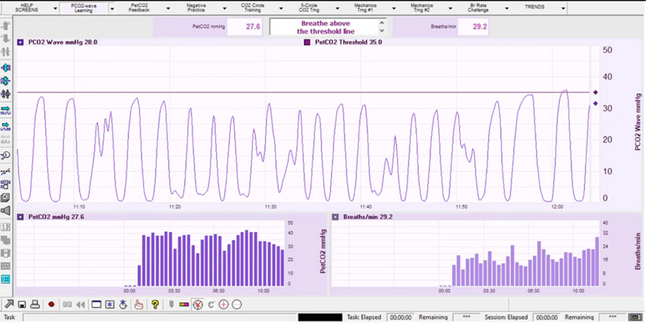
Capnography is like a window into your breath. A small nasal tube (cannula) connects you to a device called a capnometer, which measures your breathing rate, rhythm, and the amount of carbon dioxide (CO₂) in your exhaled air.
Why does this matter? CO₂ isn’t just a waste gas—it actually helps your body deliver oxygen to every cell. If CO₂ levels drop too low, your cells may not get the oxygen they need. At the same time, we use a finger sensor (oximeter) to measure your pulse and oxygen saturation, giving a complete picture of how your body is functioning with each breath.
What makes this so powerful is biofeedback. You can watch your breathing in real time and see how it changes with posture, movement, or relaxation. This immediate feedback makes it easy to notice patterns that might be contributing to symptoms like asthma, allergies, sleep problems, migraines, anxiety, or even high blood pressure. Things like sighing, gasping, or very deep inhalations often go unnoticed—but with capnography, they become visible, and we can work with you to retrain your breathing in a way that feels natural and effortless.
The readings appear as a graph called a capnogram, showing the rise and fall of CO₂ with each breath. Most healthy adults have CO₂ levels around 40 mmHg. Levels below this may indicate inefficient breathing, while higher levels are usually linked to lung conditions where air gets trapped. By watching these readings over time, you can see your progress and learn to maintain a more balanced, effective breathing pattern.
With guided breathing exercises using capnography, you can retrain your breath, relieve symptoms, and feel more in control of your body. It’s not about forcing deep breaths or counting numbers—it’s about gently discovering a way of breathing that supports your health, calm, and energy every single day.
Pulse Oximetry
Normal blood oxygen levels typically range from 96 to 98% saturation. Levels of 99–100% may seem ideal, but they can actually indicate that hemoglobin is holding on too tightly to oxygen, making it harder for oxygen to reach your cells. This pattern is often linked to over-breathing, or hyperventilation, where breathing too quickly or deeply disrupts the body’s natural balance of oxygen and carbon dioxide.